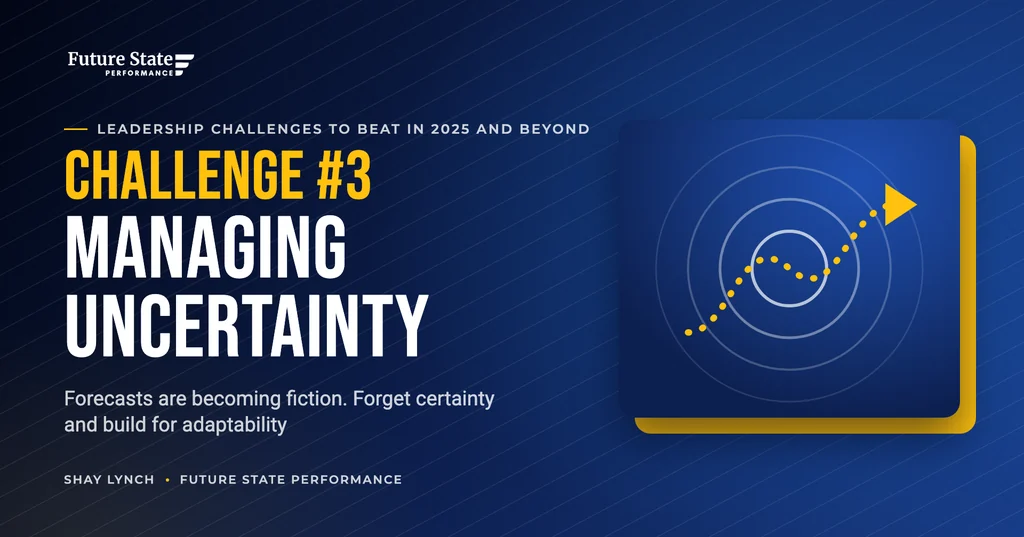
Forecasts Are Becoming Fiction – Forget Certainty & Build for Adaptability
Markets shift overnight. What worked last quarter no longer applies today.



Markets shift overnight. What worked last quarter no longer applies today.
Part one
Forecasts are foggy.
Leaders are being pulled into reactive cycles, trying to steady the business in a world that no longer follows familiar rules.
This isn’t just volatility—it’s a full-blown crisis of predictability.
And if you’re still relying on outdated forecasts and long-range plans, your strategy is already off course.
Part two
The Problem: Planning in the Fog
Businesses used to thrive on long-term visibility. Today, that’s gone.
- Market shifts are rapid and unpredictable.
- Consumer behaviour changes faster than it can be modelled.
- Political and economic signals are fragmented, often conflicting.
You can’t steer a business if you don’t know where the ground is shifting. But many leaders still try. They hold on to rigid strategies, hoping things will “settle down.”
Here’s the truth: Waiting for clarity is just another form of avoidance.
When predictability vanishes, the risk isn’t in acting too soon. It’s in standing still.
Part three
The Consequence: Paralysis and Drift
Without a clear picture, businesses:
- Delay decisions until it’s too late.
- Keep investing in old models that no longer deliver.
- Wait for “certainty” that never comes.
That hesitation creates a slow bleed:
- Confidence drops.
- Teams lose direction.
- Momentum disappears.
What starts as caution turns into complacency. And in today’s environment, that’s not safe—it’s dangerous.
Part four
The Solution: Build for Movement, Not Control
When predictability is gone, adaptability becomes the operating system.
Here’s how high-performing businesses stay steady in motion:
1. Replace Forecasts with Early Warning Systems
Instead of betting everything on projections, monitor real-time leading indicators.
- What patterns are emerging in customer behaviour?
- What are your suppliers seeing before it hits your own data?
- Which signals can your frontline teams spot before you do?
Forecasts give you a plan. Indicators give you a pulse.
2. Prioritise Business Protection Before Growth
Growth is important—but you can’t grow what you can’t protect.
Set up mechanisms to safeguard:
- Cashflow
- Core talent
- Critical supply chain relationships
- Key customer segments
If the worst happens, how quickly can you pivot without losing control?
3. Create Strategic Flex Points
Build strategy around decision points, not just deliverables.
- What would trigger a course correction?
- Which assumptions are you basing this decision on—and what happens if they change?
Stop treating your plan like a commitment. Treat it like a working model.
4. Think in 90-Day Sprints
Annual plans feel ancient in a world that changes monthly.
- Set quarterly priorities.
- Evaluate what’s working, adjust what’s not.
- Communicate fast, and often.
Shorter cycles create momentum. They also give people confidence that someone is paying attention to what’s real now—not just what was true on a spreadsheet six months ago.
In closing
The Potential: Calm Inside the Storm
You can’t control the external world—but you can build an internal engine that’s responsive, focused, and strong under pressure.
- Your team becomes more resilient—because change doesn’t feel like failure.
- Your strategy becomes clearer—because it’s built on live information, not frozen predictions.
- Your business becomes faster—because you’ve let go of the need to be perfect.
The businesses that survive this era won’t be the ones with the best 12-month forecast.
They’ll be the ones that can move, respond, and adjust—before the rest even realise the market has shifted.
So, when everything feels unpredictable, what do you lead with?
Movement. Confidence. Action.